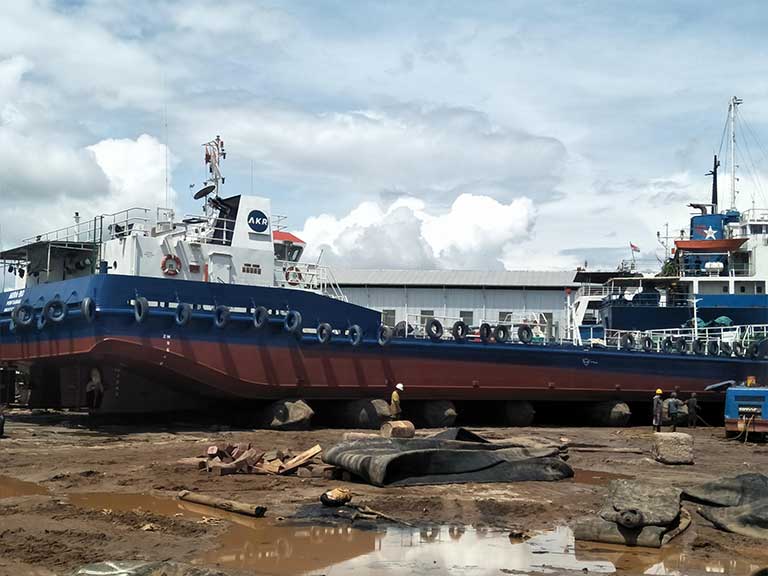
Are traditional ship launching methods still the norm in today’s maritime industry? With advancements in technology, the use of ship launching marine airbags has revolutionized the process. These marine airbags make boat launching safer, more efficient, and cost-effective.
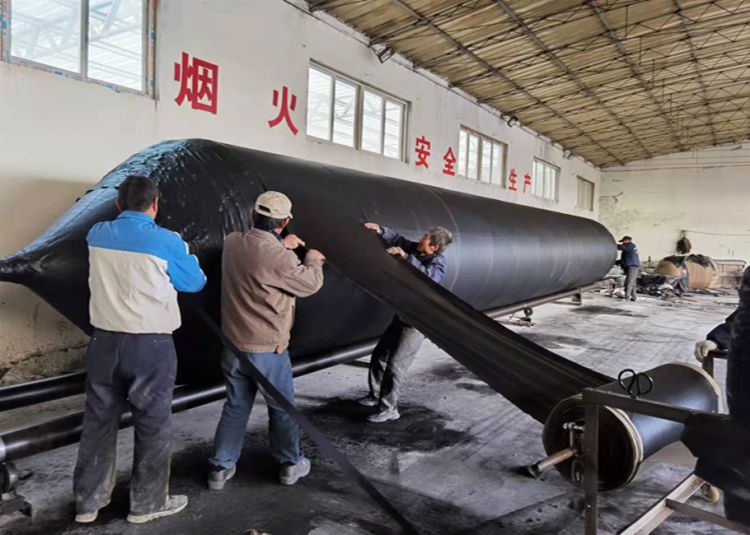
At Henger Shipping Supplies, a leading Chinese marine equipment manufacturer, we have witnessed firsthand the impact of our high-quality marine airbags on the shipbuilding industry. Our ship launching airbags are constructed from high-strength rubber and multi-layered synthetic fibers. They provide the necessary support and flexibility for a smooth launch.
What Are Ship Launching Airbags?
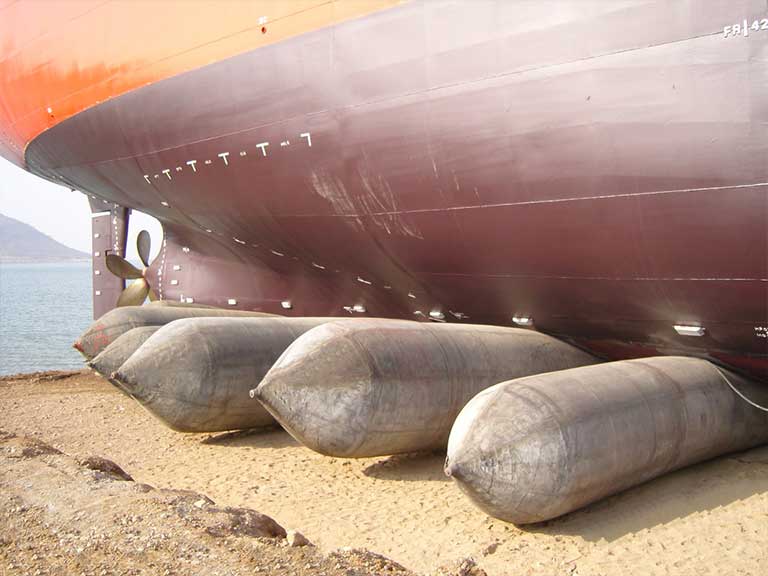
Ship launching airbags are inflatable cylindrical structures made of high-strength rubber reinforced with multiple layers of synthetic tire-cord fabric, such as nylon or polyester. They support and roll vessels during launch by inflating to lift and maneuver them into the water. These airbags comply with international standards, including ISO 14409:2011, which specifies design, manufacturing, testing, and acceptance criteria for airbags using synthetic tire-cord reinforcement layers.
The concept of using airbags for ship launching dates back several decades, with significant advancements in materials and design over the years. We have witnessed the evolution of marine airbags from simple inflatable devices to sophisticated, multi-layered structures that can handle large and complex vessels.
Learn More: What Is Ship Launching Airbag?
Key Components and Materials
A typical ship launching airbag consists of three main layers:
- Outer rubber layer: Made of abrasion-resistant natural or synthetic rubber to protect against friction and environmental damage.
- Reinforcement layer: Multiple layers (usually 4–10) of synthetic tire-cord fabric for tensile strength and pressure resistance.
- Inner rubber layer: A vulcanized airtight liner to prevent leakage.
We emphasize the importance of each layer in ensuring the durability and safety of our airbags. By combining these layers, we achieve a robust and reliable product that can withstand the stresses of the ship launching process.
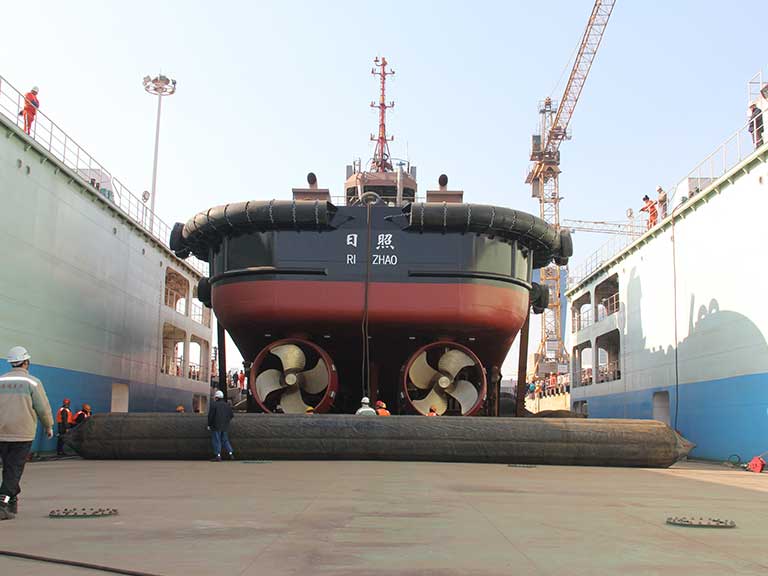
How Ship Launching Airbags Work
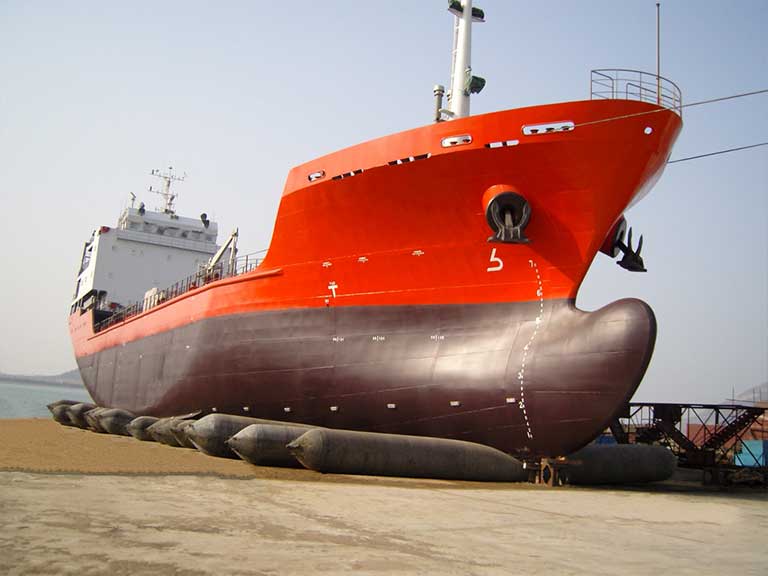
The process involves placing airbags transversely under the hull, inflating them to lift the vessel, and controlling its descent into the water using winches or gravity.
Step-by-Step Launching Process
- Site preparation: Assess slope (typically 3–8°), water depth, tide, and ground stability.
- Airbag placement: Arrange airbags in parallel rows, spaced evenly (e.g., 7–12 m apart for a 150 m vessel).
- Inflation: Gradually inflate to the working pressure (0.08–0.20 MPa, depending on size).
- Launch: Release the holding system; airbags roll as the vessel moves forward.
- Monitoring: Use pressure gauges and alignment checks.
Technical Specifications and Load Capacity Calculation
Airbag load capacity depends on diameter (D), effective length (L), working pressure (P), and safety factors. A common formula for the number of airbags (N) is:
[ N = \frac{K_1 \times Q}{P \times A \times K_2} ]
Where:
- ( Q ): Ship weight (tons)
- ( K_1 ): Safety coefficient (≥1.2)
- ( P ): Working pressure (MPa)
- ( A ): Contact area per airbag (m²)
- ( K_2 ): Other factors (e.g., buoyancy adjustment)
Detailed calculations should reference ISO 14409:2011 or consult certified engineers.
Safety Considerations During Launch
Safety is a top priority during the ship launching process using airbags. We recommend thorough planning and risk assessment before any launch operation. This includes assessing environmental conditions such as tide levels, weather, and water depth.
Our team of experts coordinates the launch operation, ensuring that the ship maintains proper alignment and controlled movement throughout the launch. We also have emergency response measures in place to handle any unexpected situations that may arise.
Manufacturing Process and Quality Standards
At Henger, we take pride in our strict manufacturing process for ship launching airbags. We aim for the highest quality and reliability. Every step, from choosing materials to testing the final product, shows our commitment to excellence.
- Raw Material Selection and Design: We pick top-notch materials for our airbags. This includes a strong outer rubber layer, a synthetic cord layer, and a vulcanized inner rubber layer. These materials ensure our airbags can handle heavy loads, resist pressure, and last longer. The careful choice and design of these parts are key to our airbags’ performance.
- Vulcanization and Reinforcement Techniques: Our process uses advanced vulcanization and reinforcement to make our airbags strong. Vulcanization makes the rubber more elastic and resistant. The reinforcement layers add even more strength and stability. This mix helps our airbags handle the stresses of launching ships.
- Quality Testing and Certification: We test our airbags thoroughly to ensure their quality and reliability. We do airtightness, pressure resistance, and anti-fatigue tests. These tests mimic real-world conditions to check our airbags’ performance and durability.
- ISO and Industry Certifications: All our products are ISO9001-2008 certified by bodies like CCS, BV, GL, ABS, LG, and IACS. This certification proves our manufacturing meets international quality standards.
Performance Testing Methods
Our testing methods are detailed and include:
- Airtightness tests are conducted to find any air leaks under high pressure.
- Pressure resistance tests are used to check the airbag’s strength and integrity.
- Anti-fatigue tests to see how the airbag performs over time.
| Test Type | Purpose | Benefit |
| Airtightness Test | Detect air leakage | Ensures airbag integrity |
| Pressure Resistance Test | Verify bearing capacity | Confirms structural integrity |
| Anti-Fatigue Test | Evaluate long-term performance | Ensures durability |
Advantages Compared to Traditional Methods
| Aspect | Airbag Launching | Traditional Slipway/Floating Dock |
|---|---|---|
| Cost | Lower (no permanent infrastructure) | High initial investment |
| Flexibility | Launch from any flat shore | Requires dedicated facilities |
| Safety | Controlled lift, reduced impact | Higher risk of hull damage |
| Reusability | 50–100+ launches per set | Permanent use |
| Environmental | Minimal site alteration | More construction impact |
Airbags have been used for vessels from 100 tons to over 100,000 DWT. For example, a large bulk carrier project used 80+ airbags for a successful launch.
FAQ
What is the typical lifespan of a marine airbag used in ship launching?
The lifespan of our marine airbags varies based on usage, maintenance, and storage conditions. A well-cared-for airbag can last 5-7 years or more.
How do I determine the correct size of the airbag for my vessel?
To find the right size, we look at the vessel’s weight, length, and beam. We also consider the water depth and how it will be launched. We work with clients to pick the perfect airbag for their needs.
Can ship launching airbags be used for vessels of all sizes?
Our airbags work well for small to medium-sized vessels. For bigger ones, we check if airbags can be used. We look at the vessel’s weight and the launching setup.
How are the airbags inspected and maintained to ensure their quality and performance?
We follow strict quality control. Our airbags are regularly checked and tested. They meet international standards and are ready for use.